Most AI security advice in 2026 is either too abstract to act on or too narrowly focused on a single attack class. This is a practical, end-to-end guide for shipping production LLM applications safely: input validation, output handling, monitoring, incident response, and the compliance posture you need before your first procurement review.
Start with a threat model
Before any controls, write down what you are defending. A one-paragraph threat model beats a fifty-page security policy. For an LLM application, answer four questions:
- What data flows into the model? User input, retrieved documents, tool outputs, system prompts, memory. Each is a separate channel.
- What data flows out? Responses to users, downstream tool calls, logs, training data. Each is a possible leak path.
- Who controls each channel? Anything not controlled by your team is untrusted by default.
- What is the worst thing the model can do?Send an email? Run code? Charge a card? That is your blast radius. Constrain it.
Input validation
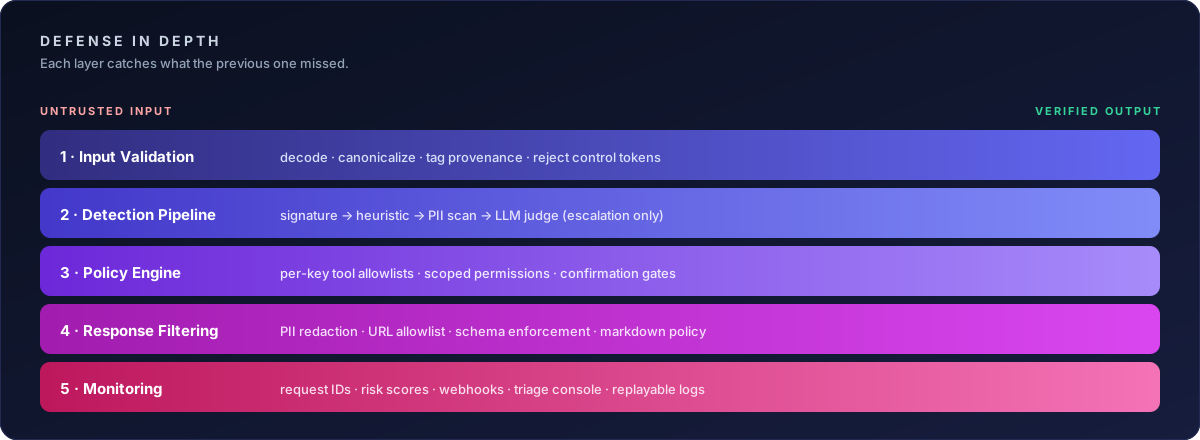
The first principle of input validation for LLMs: the entire serialized prompt is the input, not just the user's typed message. That includes retrieved documents, memory snippets, tool outputs, and any other content concatenated before the model sees it.
- Decode and canonicalize before inspecting. Base64, hex, ROT, Unicode tags, homoglyphs - all need to be normalized so a single signature catches every variant.
- Layer detectors: cheap signature matching first, then heuristics for instruction-like patterns, then an LLM judge for ambiguous cases. Each layer cuts cost by an order of magnitude.
- Tag content provenance. The model should be able to tell user-typed text from retrieved data from tool output. The proxy can wrap each segment with a sentinel so any rule can reference its source.
- Reject unrecognized input at structural boundaries. If a user message contains role tags or ChatML control tokens, that is almost always an attack.
Output filtering
The response from the model is also untrusted. Treat it like user input for any downstream system. The most expensive incidents we see in practice are output-handling failures, not prompt-injection failures: SQL generated by the model is executed verbatim, shell commands are passed to subprocess, HTML is rendered without escaping, URLs are fetched without an allowlist.
Concrete controls:
- PII and secret scanning on outbound responses. Regex for emails, phone numbers, IBANs, credit cards; entropy scanning for high-randomness tokens that look like API keys.
- URL allowlisting. Any URL the model produces should be checked against an allowlist before it is rendered as a link or, worse, fetched by an agent.
- Schema enforcement. If you expect JSON, parse it strictly and reject anything that does not match. Do not regex your way out of malformed model output.
- Content rendering policies. Markdown image tags with external URLs are a common exfiltration channel; consider stripping them in security-sensitive contexts.
Agent and tool controls
Agents fail open by default. The model can call any tool you give it, with any arguments, in any sequence, as many times as it likes. That is a great development experience and a terrible security posture.
- Per-tool scopes: which tools is this agent allowed to call, on which resources, for which tenants.
- Confirmation gates for irreversible actions. Sending an email, charging a card, deleting a record - these should require explicit user assent, not just a confident-looking model output.
- Tool-call budgets. Cap how many tool calls a single user turn can make. Loops eat money and are a common DoS vector.
- Argument validation. Validate every argument passed to a tool. Especially URLs, file paths, SQL, and shell commands.
Monitoring and detection
You cannot defend what you cannot see. Production LLM monitoring has four layers:
- Per-request observability. Every request gets a stable ID, a risk score, a list of matched detection rules, and a verdict. Stored long enough to replay incidents.
- Aggregate dashboards. Threat counts by type, risk-score distribution, top-offending API keys, expensive tenants, latency at the p50 and p99.
- Real-time alerting. Webhooks to Slack or PagerDuty for critical-severity events. Email for medium. Quiet logging for low.
- Triage workflow. A console where on-call can review flagged events, mark true and false positives, and feed the labels back into rule tuning.
Incident response
When something breaks, the first question is always "what did the model see?". If you cannot answer that question quickly, your incident response is going to be painful.
- Stable request IDs propagated across the proxy, the application, and the upstream provider. Correlation is the difference between a 30-minute and 30-hour investigation.
- Replayable logs. The serialized prompt, the detection result, the upstream response. Redacted appropriately for retention.
- Kill switches. Per-key revocation that takes effect within seconds. Per-tool disable. Per-tenant freeze. You will need them at 3am.
- Customer notification. Have the template already written. Have the legal review already done. Speed matters more than polish.
Compliance posture
Your first enterprise procurement review will ask the same six questions. Have answers ready:
- What sub-processors do you use, and where do they operate?
- How do you handle our data, and how long is it retained?
- What is your incident response process, and what is your notification SLA?
- Do you support SCCs and a DPA for international transfers?
- What is your security framework and audit posture (SOC 2, ISO 27001)?
- How do customers exercise data-subject rights?
None of these questions are about model accuracy. They are about how seriously you treat customer data. Get ahead of them; do not learn them from a sales engineer who is losing the deal.
Production readiness checklist
Before you ship an LLM feature to real users, run this checklist:
- Threat model written down and reviewed by another engineer.
- Input inspection layer in front of the model, covering every channel.
- Output filtering for PII, secrets, and unsafe URLs on the response.
- Tool calls scoped to least privilege; irreversible actions gated behind user confirmation.
- Per-request risk scoring with stable IDs and replayable logs.
- Real-time alerting wired to a channel a human actually watches.
- Per-key rate limits and token quotas with cost monitoring.
- Incident runbook in the team wiki, including a kill-switch procedure.
- Privacy notice, retention schedule, and DPA available for business customers.
- OWASP LLM Top 10 coverage map: every item has at least one mitigation.
How Context Guard implements these controls
Context Guard ships the input inspection, output filtering, tool enforcement, monitoring, and OWASP-aligned audit trail in a single drop-in proxy. You change a base URL and add a header; the rest of the checklist becomes configuration rather than infrastructure work. Detection runs at the edge with sub-30ms p50 overhead, so production traffic does not pay a tax for being secure.
Closing thought
AI security is not a fundamentally different discipline from traditional application security. It is application security where the application happens to call an LLM. The threat model is different, the input format is different, but the principles are the same: validate untrusted input, constrain blast radius, monitor everything, and be ready to respond. Teams that internalize that ship faster and break less.
Ready to defend your LLM stack?
Context Guard is the drop-in proxy that detects prompt injection, context poisoning, and data exfiltration in real time - mapped to OWASP LLM Top 10. Try it on your own traffic with a 14-day free trial, no credit card.
- < 30 ms p50 inline overhead
- Works with OpenAI, Anthropic, and any compatible upstream
- Triage console + structured webhooks
Related posts
All posts →OWASP LLM Top 10 2025: Every Risk Explained with Mitigations
Walk through every item in the OWASP LLM Top 10 with practical mitigations and a coverage map for runtime defense layers.
AI Hallucination in Production Systems: The Six Classes You Are Not Detecting
Hallucinations are the costliest LLM failures in production: fabricated citations, false customer balances, system prompt extraction. Most teams scan only the user-facing output and never inspect the full prompt as the model sees it. This post maps the six hallucination classes observed in production traffic, walks through the detection architecture that catches them before they reach users, and gives a ten-point checklist for shipping reliable LLM systems.
Context Window Overflow: How Attackers Drown Your Safety Instructions in Noise
Repetition flooding pushes system prompts past the truncation boundary. Token stuffing buries malicious instructions in 90,000 tokens of irrelevant content. Attention dilution makes safety instructions statistically invisible. Multi-channel overflow distributes the flood across RAG, tools, and memory so no single channel looks suspicious. Here are the five context overflow techniques hitting production LLM applications in 2026, the detection rules that catch them, and the three-layer defense architecture that keeps your safety instructions intact.